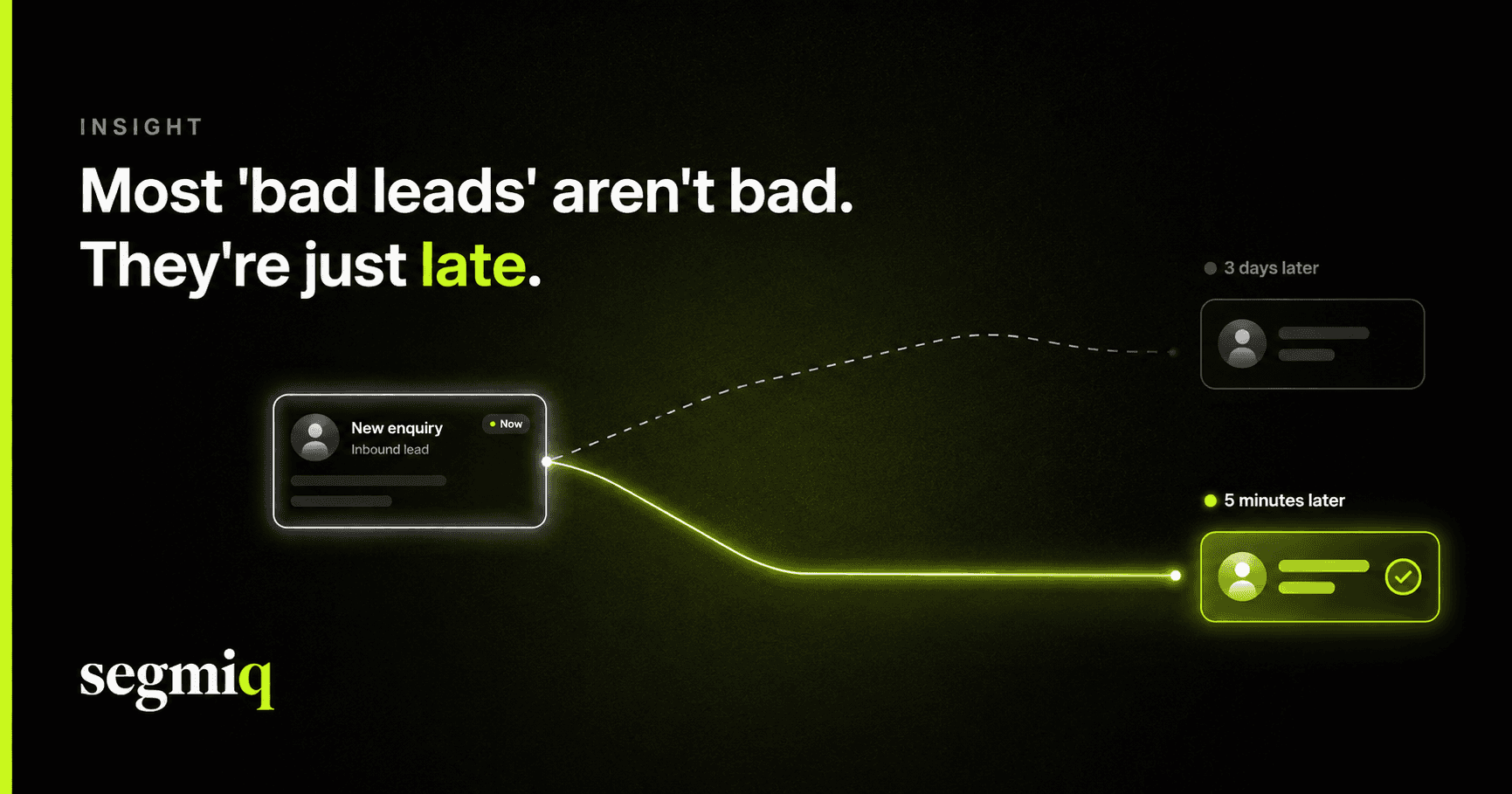
Most "bad leads" aren't bad. They're just late.
Every business owner who has run Facebook ads has said it: "the leads were rubbish." Sometimes that's true. Far more often, the lead was fine — it was the handling that failed. Here's how to tell the difference, because the two problems have opposite fixes.
There is a sentence almost every trade business owner has said at least once: "We tried Facebook ads, but the leads were rubbish." It is said with real conviction, usually after a campaign that produced a pile of enquiries and very few jobs. The conclusion feels obvious — the leads were low quality, so the channel does not work.
Sometimes that is exactly right. Bad targeting, a misleading ad, or the wrong audience will produce genuinely weak enquiries. That is a real problem with a real fix.
But far more often, the leads were not bad. They were handled in a way that guaranteed they would look bad. And these two problems — a quality problem and a handling problem — feel identical from the outside while having completely opposite solutions. Confusing them is how businesses give up on a channel that was actually working.
Here is the distinction that matters. Lead quality is about who the enquiry is: were they the right kind of person, with a real need, in your market? Lead handling is about what happened after they raised their hand: how fast you responded, how many times you followed up, and whether anyone was tracking the conversation at all.
A lead contacted three days after it came in is not a worse lead than one contacted in five minutes. It is the same lead, made cold by the delay — and the response-time research is unambiguous about how steep that cliff is. A lead followed up once and then dropped is not proof the person was never interested. Most deals are not won on the first contact; they are won on the third or fourth, by the business that kept showing up while everyone else assumed silence meant no.
So before you blame the source, ask three honest questions about the handling. How long did it actually take to make first contact — measured from when the form came in, not from when someone got around to it? How many times was each lead followed up before it was given up on? And was anyone able to see, at any point, which leads had gone quiet and were slipping away?
If the honest answers are "hours or days," "once," and "no" — then the leads were probably fine. The leak was downstream of the ad, in the part of the business that runs on memory and good intentions.
The reason this matters so much is that the two fixes pull in opposite directions. If your real problem is quality, the answer is to change the targeting and the ad — spend energy upstream. If your real problem is handling, changing the ad does nothing; you will just buy fresh leads and waste them the same way. The single most expensive mistake here is "fixing" a handling problem by blaming the leads, because it sends you off to re-do the one thing that was already working.
This is the gap Segmiq is built to close. It timestamps first contact automatically, so response time stops being a guess. It keeps a follow-up rhythm so leads are not silently dropped after one try. And it surfaces leads that have gone quiet before they die. None of that improves a genuinely bad lead — nothing can. What it does is make sure that when you judge a campaign, you are judging the leads, and not your own follow-up.
Before you decide the leads were rubbish, find out whether they ever stood a chance.