The most expensive thing in your business lives in one salesperson's phone
In most trade businesses across the region, the entire sales pipeline lives in WhatsApp threads and one person's memory. It works — right up until the day that person leaves, and the business discovers what it actually lost.
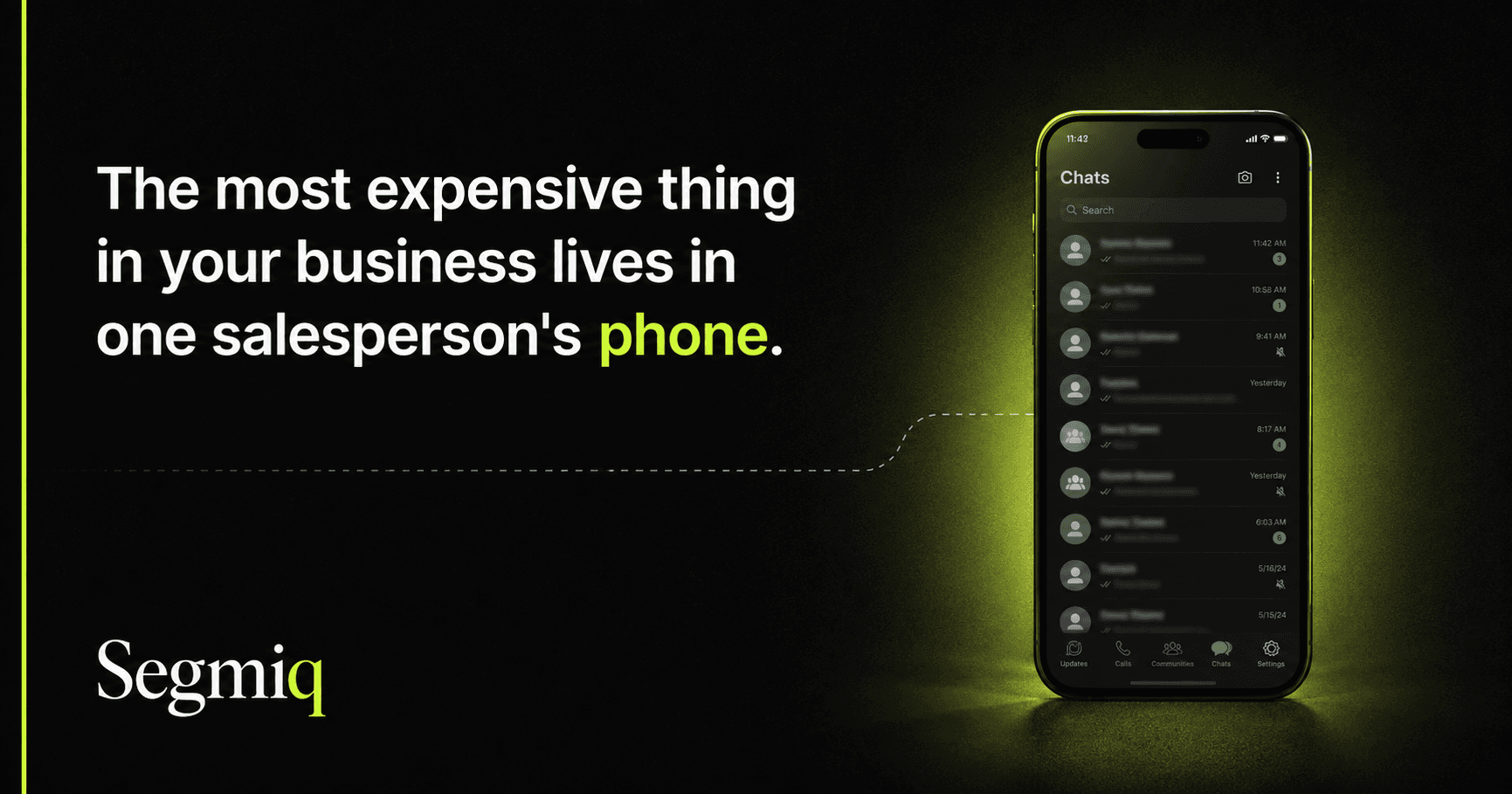
Ask the owner of a roofing or solar company where their leads are, and the honest answer is usually a phone. Specifically, the personal phone of whichever salesperson took the enquiry. The conversation is in WhatsApp. The quote is a photo of a handwritten figure. The reason the deal stalled is in that person's head, and nowhere else.
This is not laziness or bad management. It is the natural shape a small trade business takes. WhatsApp is where customers already are, so that is where the selling happens. The salesperson who built the relationship holds the context, so that is where the knowledge lives. For a long time it works perfectly well.
The problem is that it is invisible until it costs you, and when it costs you, it costs you all at once.
Picture a salesperson who has been with a contractor for two years and leaves to join a competitor — or simply leaves. On paper the business loses one employee. In reality it loses every live conversation that person was holding: the homeowner who was a week from signing, the site manager who asked for a revised quote, the three prospects who said "call me after month-end" and meant it. None of that was ever written down anywhere the business could see. It walks out the door inside a phone, and in the worst case it walks straight into a competitor's pipeline.
The damage is not only departures. The same blind spot shows up every ordinary week. A lead goes quiet for ten days and nobody notices, because no one was watching that thread. A customer is followed up twice by two different people who did not know the other had called, which makes the company look disorganised at exactly the wrong moment. A promising enquiry is simply forgotten, not because anyone decided to drop it, but because there was no list — only a memory, and memory is not a system.
What is actually missing is a shared record. Not surveillance of the salesperson, and not a heavy corporate CRM built for a different kind of company. Just one place where every lead, every conversation, and every reason a deal moved or stalled is captured as it happens — so that the knowledge belongs to the business, not to whoever happened to take the call.
When that record exists, the departure stops being a catastrophe. A new salesperson can pick up a live deal and see what was quoted, what was promised, and where the conversation paused. A manager can see a lead going quiet before it dies. Two people stop calling the same customer. The business keeps what it paid to acquire.
This is the quiet logic behind how Segmiq is built. Every lead has a timeline — every message, every call outcome, every handover note — and it lives with the business, not the handset. When a salesperson is reassigned, the next person inherits a briefing, not a blank page. The relationship still matters; the salesperson still matters. But the pipeline is no longer something that can be carried out the door.
The most expensive asset most trade businesses own is the one they can least afford to keep in one person's pocket.