

What a quote request tells you before anyone picks up the phone
Two enquiries can look identical in an inbox and be worth completely different amounts of your time. Here is exactly what separates them — and how a system reads the difference before a salesperson dials.
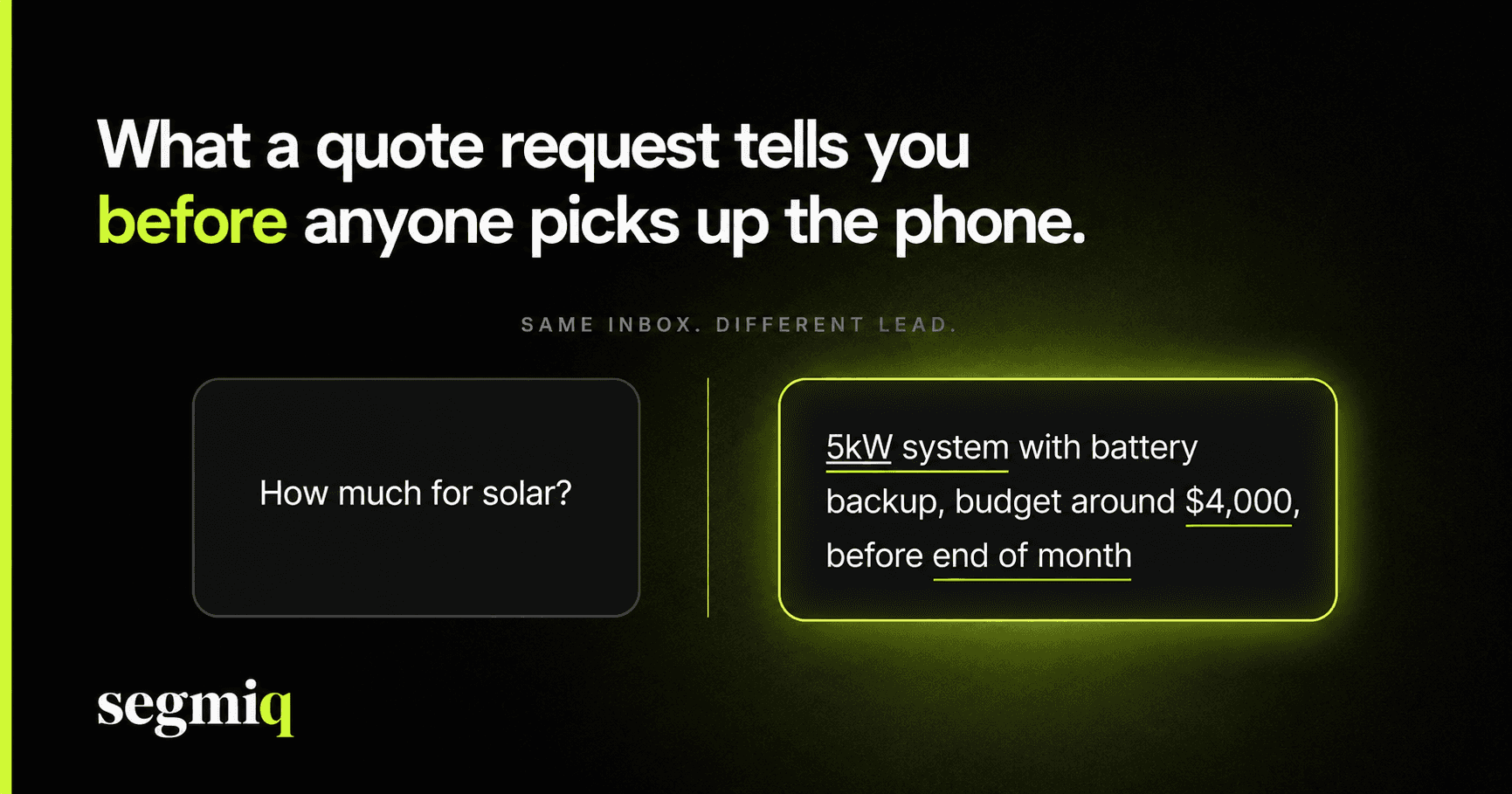
Two leads land within a minute of each other. The first says: "How much for solar?" The second says: "Need a 5kW system with battery backup installed before the end of the month, budget around US$4,000, property in Borrowdale." In an inbox, these are two unread rows. In reality, they are not remotely the same lead — and the order in which you call them back changes how much money you make this week.
Every trade business already makes this judgement. The experienced salesperson glances at an enquiry and knows, roughly, whether it is serious. The trouble is that the judgement lives in one person's instinct, it is inconsistent, and it does not scale past the number of leads one person can hold in their head at once. When fifty enquiries come in from a campaign, instinct quietly gives up and people just work top to bottom.
What a good system does is make that judgement explicit and apply it to every lead, every time. It is worth understanding the mechanism, because it is not magic and it is not guessing.
A quote request carries signals, and the signals are readable. Three matter most.
The first is specificity. Vague enquiries and precise enquiries behave differently. "How much for solar?" is a person at the start of thinking about it. "5kW with battery backup" is a person who has already done homework, talked to a neighbour, and arrived with a shape in mind. Specificity is not a guarantee, but across many leads it tracks closely with how far along someone is.
The second is budget language. A prospect who volunteers a number — even a rough one — has mentally committed to spending. A prospect who avoids the question is either early or price-shopping. Neither is bad, but they need different handling, and they should not sit in the same queue.
The third is urgency. "Before the end of the month" and "thinking about it for next year" are both legitimate, but they decay at completely different speeds. The month-end lead is the one where five minutes of silence costs you the deal, the way the response-time research shows. The next-year lead can wait a day without harm.
Read those three signals together and you can do something simple but powerful: order the queue. The lead that is specific, has named a budget, and is in a hurry goes to the top. The vague, no-budget, no-rush enquiry is still worth a call — it is not a bad lead — but it should not be the reason a ready-to-buy customer waited two hours.
This is what Segmiq's lead scoring does. When a form is submitted, it reads the enquiry for exactly these kinds of signals — project specificity, budget confidence, urgency — and turns them into an intent picture, so the salesperson opens their list already sorted by who is most ready, rather than by who happened to arrive first. (The examples above are illustrative; the mechanism is what matters.)
Two things are worth being clear about. First, a score is a starting point for a human, not a verdict. A low-signal enquiry can become a strong customer the moment a salesperson asks one good question. The system orders the work; the person still does the work. Second, this is not about ignoring anyone. Every lead gets contacted. The scoring only decides what gets contacted first, which on a busy day is the entire game.
The skill of reading an enquiry was always there in your best salesperson's head. The only change is that it now applies to all fifty leads at once, consistently, before anybody picks up the phone.